
This dataset integrates Member States' official data on the location of education services. Additional information on these services is included when available. See Details.
Usage
gisco_get_education(
  year = c(2023, 2020),
  cache = TRUE,
  update_cache = FALSE,
  cache_dir = NULL,
  verbose = FALSE,
  country = NULL
)Arguments
- year
A character string or numeric value with the release year of the file. One of
2023,2020.- cache
A logical value indicating whether to cache results. Defaults to
TRUE. See the Caching strategies section ingisco_set_cache_dir().- update_cache
A logical value indicating whether to refresh the cached file. Defaults to
FALSE. When set toTRUE, it forces a new download.- cache_dir
A character string with a path to a cache directory. See the Caching strategies section in
gisco_set_cache_dir().- verbose
A logical value indicating whether to display informational messages.
- country
A character vector of country codes. It can be either a vector of country names, a vector of ISO 3166-1 alpha-3 country codes or a vector of Eurostat country codes. See also
countrycode::countrycode().
Value
An sf object.
Details
Files are distributed in EPSG:4326.
The following table describes the education service attributes:
| Attribute | Description |
id | The education service identifier, based on national identification codes when available. |
name | The name of the educational institution. |
site_name | The name of a specific site or branch of the educational institution. |
lat | Latitude (WGS 84). |
lon | Longitude (WGS 84). |
street | Street name. |
house_number | House number. |
postcode | Postcode. |
address | Address information when the source does not separate address components. |
city | City name. In some sources, this refers to a region or municipality. |
cntr_id | Country code (2 letters, ISO 3166-1 alpha-2). |
levels | Education levels represented by a single integer or range, using ISCED 2011. |
max_students | Maximum student capacity. |
enrollment | Number of enrolled students. |
fields | Academic disciplines in which the institution specializes, using ISCED-F 2013. |
facility_type | Type of institution by ownership and operation, such as Catholic or international. |
public_private | Public or private status of the education service. |
tel | Telephone number. |
email | Email address. |
url | URL for the institution's website. |
ref_date | The reference date (DD/MM/YYYY) for the data. |
pub_date | The publication date of the dataset by Eurostat (DD/MM/YYYY). |
geo_qual | Geolocation quality indicator: 1 = Good, 2 = Medium, 3 = Low, 4 = From source, -1 = Unknown, -2 = Not geocoded. |
comments | Additional information on the education service. |
Copyright
The general Eurostat copyright and license provisions apply. Detailed metadata also list source-specific licensing conditions by country and data provider. Review the conditions for the selected data before use.
Data quality
The data are extracted from official national registers. They may contain inconsistencies, inaccuracies and gaps due to the heterogeneity of the national input data.
See also
Basic service datasets:
gisco_get_healthcare()
Examples
# \donttest{
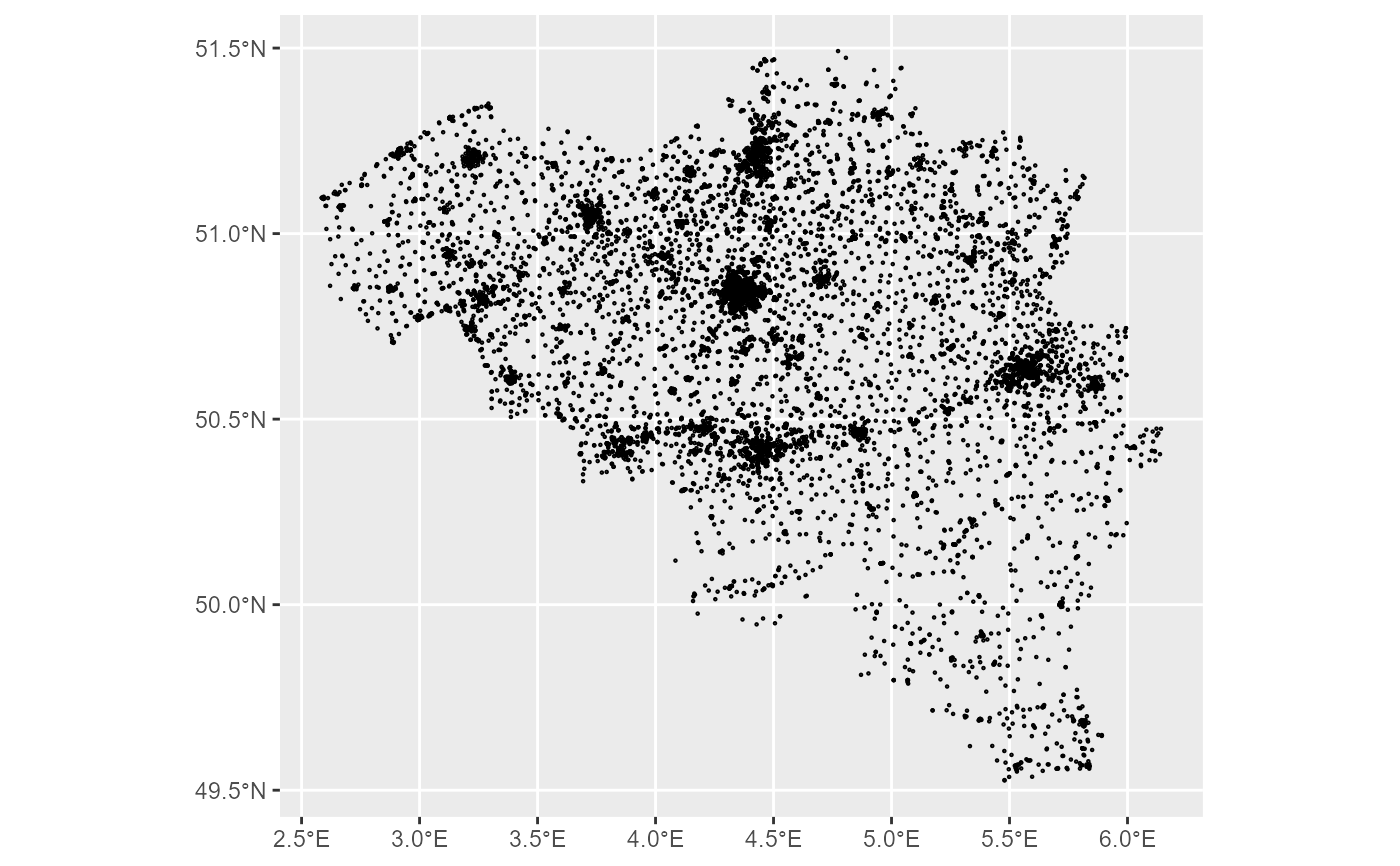
edu_austria <- gisco_get_education(country = "Austria", year = 2023)
# Plot if downloaded.
if (!is.null(edu_austria) && requireNamespace("ggplot2", quietly = TRUE)) {
austria_nuts3 <- gisco_get_nuts(country = "Austria", nuts_level = 3)
library(ggplot2)
ggplot(austria_nuts3) +
geom_sf(fill = "grey10", color = "grey60") +
geom_sf(
data = edu_austria, aes(color = rev(public_private)),
alpha = 0.25
) +
theme_void() +
theme(
plot.background = element_rect(fill = "black"),
text = element_text(color = "white"),
panel.grid = element_blank(),
plot.title = element_text(face = "bold", hjust = 0.5),
plot.subtitle = element_text(face = "italic", hjust = 0.5)
) +
labs(
title = "Education", subtitle = "Austria (2023)",
caption = "Source: Eurostat, Education 2023 dataset.",
color = "Type"
) +
coord_sf(crs = 3035)
}
 # }
# }