
Functions to interact with the GISCO ID service API, which returns attributes and, optionally, geometry for different datasets at specified coordinates in the selected coordinate reference system.
Each endpoint has a corresponding function in giscoR. See Details for the lookup modes supported by these functions.
Usage
gisco_id_api_geonames(
  x = NULL,
  y = NULL,
  xmin = NULL,
  ymin = NULL,
  xmax = NULL,
  ymax = NULL,
  verbose = FALSE
)

gisco_id_api_nuts(
  x = NULL,
  y = NULL,
  year = 2024,
  epsg = c(4326, 4258, 3035),
  verbose = FALSE,
  nuts_id = NULL,
  nuts_level = NULL,
  geometry = TRUE
)

gisco_id_api_lau(
  x,
  y,
  year = 2024,
  epsg = c(4326, 4258, 3035),
  verbose = FALSE,
  geometry = TRUE
)

gisco_id_api_country(
  x,
  y,
  year = 2024,
  epsg = c(4326, 4258, 3035),
  verbose = FALSE,
  geometry = TRUE
)

gisco_id_api_river_basin(
  x,
  y,
  year = 2019,
  epsg = c(4326, 4258, 3035),
  verbose = FALSE,
  geometry = TRUE
)

gisco_id_api_biogeo_region(
  x,
  y,
  year = 2016,
  epsg = c(4326, 4258, 3035),
  verbose = FALSE,
  geometry = TRUE
)

gisco_id_api_census_grid(
  x,
  y,
  year = 2021,
  epsg = c(4326, 4258, 3035),
  verbose = FALSE,
  geometry = TRUE
)Arguments
- x, y
A character string or numeric value with the coordinates to identify, expressed in the CRS selected by
epsg. For Geonames, use longitude and latitude in EPSG:4326.- xmin, ymin, xmax, ymax
A character string or numeric value with bounding box coordinates in EPSG:4326 to identify geonames within the box. The extent must not exceed five degrees in either dimension.
- verbose
A logical value indicating whether to display informational messages.
- year
A character string or numeric value with the dataset year, see Details.
- epsg
A character string or numeric value with the EPSG code for the coordinate reference system of the input coordinates and returned geometry. One of
4326,4258or3035. This argument is sent as the API'sprojparameter.- nuts_id
A character string with the NUTS ID code.
- nuts_level
A character string or numeric value with the NUTS level. One of
0,1,2or3. This argument is sent as the API'slevelparameter. IfNULL, the service uses level3for coordinate lookups.- geometry
A logical value indicating whether to return geometry. If
TRUE, ansfobject is returned. IfFALSE, a tibble is returned.
Value
A tibble when geometry = FALSE, or an
sf object when geometry = TRUE. Geonames always returns
an sf object. Failed requests return NULL.
Details
The service also supports identifier lookups for other datasets and
Geonames name searches. These lookup modes are not exposed by the
corresponding functions in giscoR. Only the NUTS function
supports lookup by ID through nuts_id.
The available endpoints are:
gisco_id_api_geonames(): Get geographic placenames from longitude and latitude coordinates or a bounding box.gisco_id_api_nuts(): Return NUTS regions from coordinates or an ID. Accepted values foryear:"2024","2021","2016","2013","2010","2006".gisco_id_api_lau(): Return the ID and, optionally, geometry for Local Administrative Units (LAU) at specified coordinates. Accepted values foryear:"2024","2023","2022","2021","2020","2019","2018","2017","2016","2015","2014","2013","2012","2011".gisco_id_api_country(): Return the ID and, optionally, geometry for countries at specified coordinates. Accepted values foryear:"2024","2020","2016","2013","2010","2006".gisco_id_api_river_basin(): Return the ID and, optionally, geometry for river basins at specified coordinates, based on the Water Framework Directive (WFD) reference spatial datasets. Accepted values foryear:"2024","2023","2022","2021","2020","2019".gisco_id_api_biogeo_region(): Return the ID and, optionally, geometry for biogeographical regions at specified coordinates. The biogeographical regions dataset contains the official delineations used in the Habitats Directive (92/43/EEC) and for the EMERALD Network. Accepted values foryear:"2016".gisco_id_api_census_grid(): Return the ID and, optionally, geometry for census grid cells at specified coordinates. Accepted values foryear:"2021".
See also
gisco_get_nuts(), gisco_get_lau(), gisco_get_countries(),
gisco_get_census() and gisco_address_api.
GISCO API tools:
gisco_address_api
Examples
# \donttest{
gisco_id_api_geonames(x = -2.5, y = 43.06)
#> Simple feature collection with 10 features and 8 fields
#> Geometry type: POINT
#> Dimension: XY
#> Bounding box: xmin: -2.520847 ymin: 43.06455 xmax: -2.491494 ymax: 43.07037
#> Geodetic CRS: WGS 84
#> # A tibble: 10 × 9
#> name type country language localtype distanceMeters endlifespanversion
#> * <chr> <chr> <chr> <chr> <chr> <dbl> <chr>
#> 1 Arrasate admi… Spain baq Administ… 809. NA
#> 2 Mondragón admi… Spain spa Administ… 809. NA
#> 3 Arrasate admi… Spain baq Administ… 809. NA
#> 4 Arrasate admi… Spain baq Administ… 809. NA
#> 5 Mondragón admi… Spain spa Administ… 809. NA
#> 6 Mondragón admi… Spain spa Administ… 809. NA
#> 7 Arrasate/… popu… Spain spa BUILTUPP 858. NA
#> 8 Arrasate/… popu… Spain spa BUILTUPP 858. NA
#> 9 Arrasate/… popu… Spain spa BUILTUPP 858. NA
#> 10 Garagartza popu… Spain baq BUILTUPP 2052. NA
#> # ℹ 2 more variables: beginlifespanversion <date>, geometry <POINT [°]>
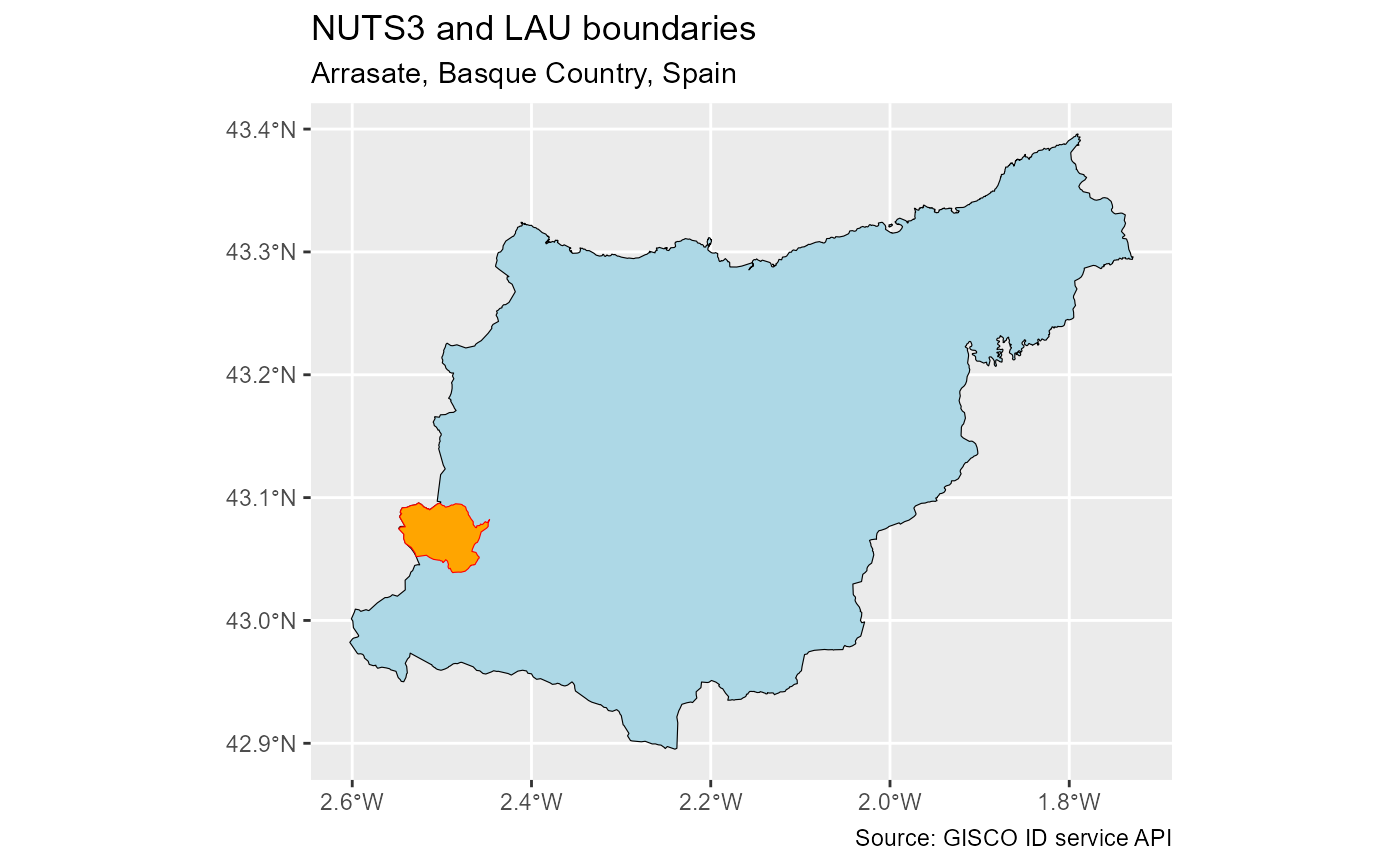
lau <- gisco_id_api_lau(x = -2.5, y = 43.06)
nuts3 <- gisco_id_api_nuts(x = -2.5, y = 43.06, nuts_level = 3)
if (
all(!is.null(lau), !is.null(nuts3)) &&
requireNamespace("ggplot2", quietly = TRUE)
) {
library(ggplot2)
ggplot(nuts3) +
geom_sf(fill = "lightblue", color = "black") +
geom_sf(data = lau, fill = "orange", color = "red") +
labs(
title = "NUTS 3 and LAU boundaries",
subtitle = "Arrasate, Basque Country, Spain",
caption = "Source: GISCO ID service API"
)
}
 # }
# }